Why it matters
Quick sort is one of the fastest general-purpose sorts in practice, and it is one of the most common interview topics. Its central step, partitioning, does more than sorting. It also solves "find the k-th largest element" problems, and it teaches a lesson about worst cases that every serious programmer needs to know.
By the end of this lesson you will partition an array by hand, write quick sort in C++, explain why a bad pivot choice makes it slow, and use quickselect to find a value without sorting everything. You will also see why quick sort is not stable, and how to handle many equal values.
The idea: put the pivot in its place first
Merge sort does its real work after the recursive calls, when it merges two sorted halves. Quick sort does the work before the recursive calls. It picks one value, called the pivot, and rearranges the array so that every smaller value sits to the left of the pivot and every bigger value sits to the right. This rearrangement is called partitioning.
Here is an analogy. Imagine a class of students standing in a line by height, and you need them sorted. You pick one student at random and ask everyone shorter to step to the left and everyone taller to step to the right. The chosen student is now standing in the place where they belong. Nobody on the left is taller, and nobody on the right is shorter. You then repeat the same process inside the left group and inside the right group.
After one partition, the pivot is in its final sorted position, and it will never move again. The left part and the right part are not sorted yet, but each one is smaller than the pivot and bigger than the pivot, so the problem has been split into two smaller problems. That is divide and conquer with the work done up front.
Quick sort has three steps.
- Partition the range around a pivot. Put the pivot in its final place.
- Recurse on the left part, the values smaller than the pivot.
- Recurse on the right part, the values bigger than the pivot.
There is no combine step. When both parts are sorted, the whole array is sorted, because the pivot already sits between them.
One partition step, slowly
There are several ways to partition. This module uses the Lomuto scheme, which is easy to follow. Lomuto uses the last value in the range as the pivot. It keeps one index, i, which marks the next free slot for a small value. It walks through the range with j. Whenever a[j] is smaller than the pivot, it swaps a[j] into the slot at i and moves i forward. At the end, the pivot is swapped into slot i.
Take the array 10 7 8 9 1 5. The pivot is the last value, 5. The table shows each step.
| j | Value a[j] | Smaller than 5? | Action | Array after the step |
|---|---|---|---|---|
| 0 | 10 | No | Nothing | 10 7 8 9 1 5 |
| 1 | 7 | No | Nothing | 10 7 8 9 1 5 |
| 2 | 8 | No | Nothing | 10 7 8 9 1 5 |
| 3 | 9 | No | Nothing | 10 7 8 9 1 5 |
| 4 | 1 | Yes | Swap with slot i = 0, then i becomes 1 | 1 7 8 9 10 5 |
| end | Swap the pivot into slot i = 1 | 1 5 8 9 10 7 |
After the last step, the pivot 5 sits at index 1. Everything to its left is smaller than 5, which is just the value 1. Everything to its right is bigger than 5. The partition function returns the index 1, so the caller knows where the pivot is.
The diagram shows the same array after each important swap.
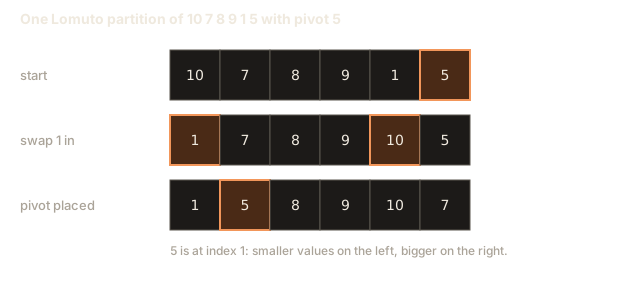
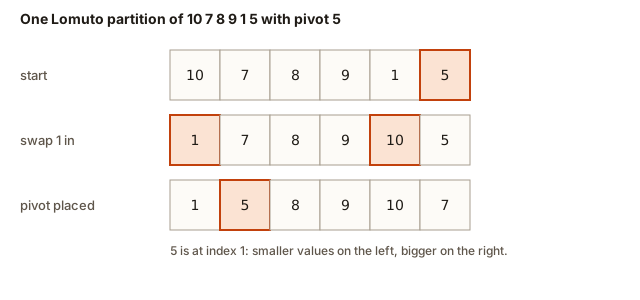 One Lomuto partition of 10 7 8 9 1 5 with pivot 5, showing the swap that moves 1 to the front and the final swap that places the pivot
Now run the partition by itself. The program below reads an array, partitions it using the last value as the pivot, and prints the result and the pivot index.
Press Run and type this in the Input box:
6
10 7 8 9 1 5
The output is:
1 5 8 9 10 7
pivot index 1
The output matches the table. The array is not sorted. The values on each side of the pivot are not sorted either. Only the pivot is in its final place. That is all one partition promises, and the recursion does the rest.
Quick sort: partition, then recurse
The quick sort function is short. It calls partition on the range, then calls itself on the two parts on either side of the pivot. The pivot index is excluded from both calls, because it is already in its final place.
void quickSort(vector<int>& a, int lo, int hi) {
    if (lo >= hi) return;              // zero or one value: already sorted
    int p = partition(a, lo, hi);
    quickSort(a, lo, p - 1);
    quickSort(a, p + 1, hi);
}
The base case is the same as in merge sort: a range with zero or one value. Watch the arithmetic in the two recursive calls. The left call stops at p - 1 and the right call starts at p + 1. If you wrote quickSort(a, lo, p) instead, the same pivot would be included again, and the range would never shrink in some cases, causing an infinite loop.
The visualizer below runs the whole process, one partition at a time. Watch the pivot turn into a fixed value after each partition, and watch the ranges on each side get smaller.
Outlined bars are being compared. Filled bars were just swapped or written. Bars with a dark border are in their final place. A triangle marks the pivot. Faded bars are outside the part being worked on.
Pick a pivot, move smaller items before it and larger after it, then repeat on each side.
Quick sort is the usual choice when speed on typical data matters and memory is tight. It sorts in place, so it does not need a second array the size of the input. Its recursion depth is usually about log n. The cost depends on how evenly each partition splits the range, which is the subject of the next section.
Pick a better pivot
If every partition splits the range into two equal halves, there are log n levels, and each level does about n work. That gives O(n log n) time, the same as merge sort. The question is how to get balanced splits.
The Lomuto scheme uses the last value as the pivot. If the input is random, that value is a typical value, so the split is usually reasonable. If the input is already sorted, the last value is the biggest value. Then every partition puts the pivot at the far right, and the left part holds everything else. The split is as unbalanced as possible. The next section shows the cost.
A common fix is median of three. Look at three values: the first, the middle and the last. Put them in order, so that the first is smallest and the last is biggest. The middle of the three is the median. Move that median to the last position and partition with it. On sorted data the first value is the smallest, the last value is the biggest, and the middle value is the median. So the median of three is always the middle value. That gives a balanced split for sorted input.
The next program uses median of three. It reads an array, sorts it with the improved quick sort, and prints the result.
Type this in the Input box, and press Run:
8
5 1 9 3 7 2 8 6
The output is:
1 2 3 5 6 7 8 9The function medianOfThreeToEnd does not sort the whole range. It only places three values so that the median is at hi. That is enough for the partition to work well. Notice that the code uses a[mid] and a[hi] with swap calls in a fixed order. The order of the three swaps is what makes the result the median. Changing the order can leave a value that is not the median in the pivot slot, which still sorts correctly but loses the balanced split.
The worst case, measured
Now the worst case becomes concrete. The next program counts comparisons. A comparison is one check of a[j] < pivot inside the partition. It sorts the numbers 1 to n, which are already sorted, in two ways: once with the last value as the pivot, and once with median of three. The input is 1000.
Type 1000 in the Input box and press Run. The output is:
last element as pivot: 499500 comparisons
median of three: 7987 comparisons
The first number is exact. With the last value as pivot, each partition of a range of size m makes m - 1 comparisons and puts the pivot at the far right. The ranges are 1000, 999, 998 and so on down to two values. The total is 999 + 998 + ... + 1, which is 1000 * 999 / 2, or 499500. For 1000 values that is about 500 times the work of a balanced sort.
The second number is much smaller, 7987. With median of three, the splits are balanced, so the work is about n log n, which is 10000 for n = 1000. The exact count is slightly smaller than the rough estimate because the last levels have fewer values.
The picture below shows the bad case as a sequence of partitions. Each level places only one value, and the rest of the work falls on the one remaining part.
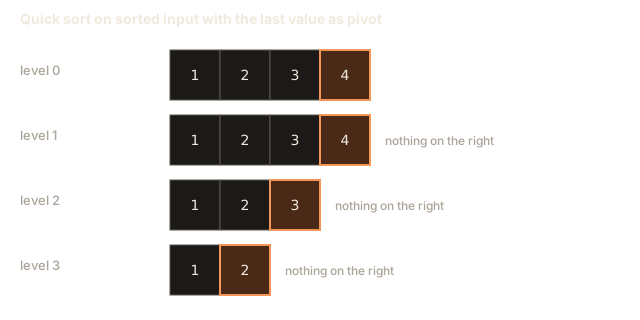
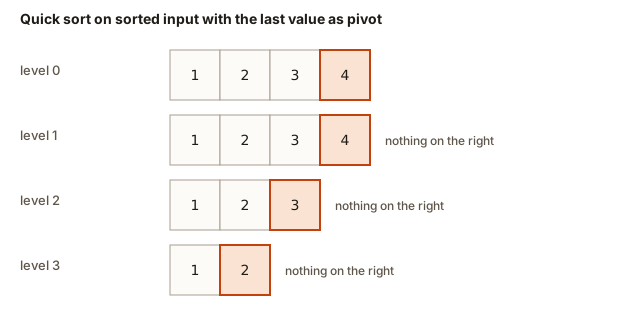 Quick sort on sorted input with the last value as pivot, where each level places only the pivot and the whole rest goes to one side
The lesson to take from this is simple. Quick sort is fast on average, but its worst case is O(n squared), which means work that grows with the square of the input. The worst case is not rare for structured inputs such as sorted or nearly sorted data, which are common in real systems. You must guard against it with a better pivot choice or with randomness.
Random pivots
Another defence is to choose the pivot at random. Swap a random position in the range with the last position, and then partition as usual. An adversary who does not know your random choices cannot build an input that is slow every time. The expected cost on any input becomes O(n log n), although a single unlucky run can still be slow.
#include <random>
mt19937 rng(12345);

void quickSortRandom(vector<int>& a, int lo, int hi) {
    if (lo >= hi) return;
    int r = uniform_int_distribution<int>(lo, hi)(rng);
    swap(a[r], a[hi]);                 // random pivot moved to the end
    int p = partition(a, lo, hi);
    quickSortRandom(a, lo, p - 1);
    quickSortRandom(a, p + 1, hi);
}
The mt19937 generator is a standard random number source in C++. Setting a fixed seed like 12345 makes the program repeatable, which is useful for tests and for debugging. For a real program you would seed it with random_device or the clock. The result is the same sorted array either way, but the order of partitions differs.
Median of three and random pivots are both good choices. Many library sorts use a mix of the two, with a fallback to a different algorithm when the recursion goes too deep. You do not need that detail for this module. You do need to know that a fixed rule like "always use the last value" is unsafe on structured input.
Quickselect: the k-th smallest without a full sort
Sometimes you do not need the whole array sorted. You may only need the 3rd smallest score, or the median, or the 10 largest values. Sorting everything would do more work than needed. Quickselect uses the partition step to answer this kind of question faster.
After one partition, the pivot is at its final index p. Its index tells you its rank. If p equals the position you want, the pivot is the answer. If the position you want is smaller than p, the answer lies in the left part, so you recurse only on the left. If it is bigger, you recurse only on the right. Half of the work is thrown away each time, on average.
The next program uses quickselect to find the k-th smallest value. It reads n and k, then n values, and prints the value at place k. Place 1 is the smallest value.
Type this in the Input box, and press Run:
6 3
7 10 4 3 20 15
The output is 7. In sorted order the values are 3 4 7 10 15 20, and the third smallest is 7.
Trace the first partition. The pivot is 15, the last value. The values smaller than 15 are 7, 10, 4 and 3, and they are moved to the front, in some order. The pivot lands at index 4, because four values are smaller. The target place is index 2 (0-based), which is on the left of 4. So the search continues on the left part, 7 10 4 3, with the same target. The next partition finishes the job.
The cost is linear on average. The first pass looks at n values, the second at about n / 2, the third at about n / 4, and so on. The sum is about 2n, which is O(n). That is much better than sorting, which costs O(n log n). The worst case is still O(n squared), for the same reason as quick sort, so random pivots are used in serious implementations.
Duplicates and three-way partition
Quick sort has one more trap, and it is common in real data: many equal values. The Lomuto partition sends every value that is smaller than the pivot to the left, and every value that is not smaller to the right. Equal values go to the right, together with the bigger values. If every value is equal, the right part always holds all the other values, and the split is as unbalanced as possible.
Test it in your head with eight equal values. The first partition moves nothing, the pivot lands at the start, and the right part has seven values. The next partition does the same to seven values, then six, and so on. The number of comparisons is 7 + 6 + ... + 1, which is 28, the same pattern as the sorted case. With a thousand equal values you would get about 500000 comparisons.
The fix is a three-way partition. It splits the range into three parts: smaller than the pivot, equal to the pivot, and bigger than the pivot. The equal part is already in its final place, so the recursion does not have to visit it. The idea is also called the Dutch national flag partition, because it sorts three colours in one pass.
void quickSort3(vector<int>& a, int lo, int hi) {
    if (lo >= hi) return;
    int pivot = a[lo + (hi - lo) / 2];
    int lt = lo, i = lo, gt = hi;
    while (i <= gt) {
        if (a[i] < pivot) swap(a[lt++], a[i++]);
        else if (a[i] > pivot) swap(a[i], a[gt--]);
        else i++;
    }
    quickSort3(a, lo, lt - 1);
    quickSort3(a, gt + 1, hi);
}
The three parts are lo to lt - 1 for smaller values, lt to gt for equal values, and gt + 1 to hi for bigger values. The loop moves values into the correct part as it scans. When a value is bigger, it swaps it with the one at gt and shrinks the scan from the right, but it does not move i, because the swapped-in value has not been checked yet. That detail is the most common bug in this function, so write it out on paper once.
Quickselect needs the same change. Without it, the k-th smallest among many equal values can take quadratic time. The practice exercises ask you to add it.
Quick sort is not stable
Recall the stability idea from the previous lesson. A stable sort keeps equal items in their original order. Quick sort does not, and you can see why by looking at a swap. Take the array 2a 2b 1, where 2a and 2b are two items with the same key 2, and 2a comes first. The pivot is 1, the last value. Nothing is smaller than 1, so i stays at 0. The loop does nothing, and the final swap exchanges a[0] with the pivot. The array becomes 1 2b 2a. Now 2b comes before 2a, and their original order is gone.
Merge sort keeps equal items in order because it never jumps an item over another equal item. Quick sort jumps items across the array to build the partition, and those jumps can reverse equal items. When stability matters and the data is an array of records, use merge sort, or a stable library sort. If you do not need stability, quick sort's speed and low memory use make it a strong choice.
Complexity summary
| Method | Average time | Worst time | Extra memory | Stable |
|---|---|---|---|---|
| Quick sort, last value as pivot | O(n log n) on random input | O(n squared) on sorted input | O(log n) stack on average | No |
| Quick sort, median of three | O(n log n) on common inputs | O(n squared) in rare cases | O(log n) | No |
| Quick sort, random pivot | O(n log n) expected | O(n squared), very unlikely | O(log n) | No |
| Three-way quick sort | O(n log n) on random input | O(n squared) if pivots are bad | O(log n) | No |
| Quickselect | O(n) expected | O(n squared) | O(1) if written as a loop | No |
The table shows the trade-off. Quick sort is fast and uses little memory, but its guarantee depends on the pivot choice. Merge sort gives a guarantee and stability, at the cost of an extra array.
Common mistakes
Forgetting the final swap. Without swap(a[i], a[hi]), the pivot is never placed. The result looks partly sorted, and the partition returns an index that does not match the pivot. Print the array after each partition to catch this.
Using p instead of p - 1 or p + 1 in the recursive calls. The pivot is already in place, so including it wastes work. Worse, using p on the right side can make the range stop shrinking, which repeats the same call forever.
Using <= on one side and < on the other. Mixing the two conditions can give uneven splits when values are equal, and in some versions it makes the loop run past the end of the range. Pick one convention and keep it.
Recursing on the whole range when only one side is needed. Quickselect must recurse on one side only. Recursing on both sides turns it into a full sort, and the algorithm loses its linear average.
Using a fixed pivot on structured data. Sorted input, reversed input and input with many equal values can all trigger the worst case. Use median of three, a random pivot, or a three-way partition.
Deep recursion on bad input. When the pivot is always the largest value, the recursion depth is about n, and each level keeps a stack frame. A very large input can exhaust the stack. Recursing on the smaller side first, or using a loop with an explicit stack, keeps the depth to about log n.
Debugging a quick sort
Quick sort bugs are usually visible in one partition. When the output is wrong, print the array and the pivot index for the first call, then check the partition by hand. The partition is correct when everything left of the pivot is smaller, everything right of it is bigger or equal, and the pivot is at the returned index.
Use the partition program from this lesson. Remove the final swap line and run the same input with 6 and 10 7 8 9 1 5. The output becomes 1 7 8 9 10 5 with pivot index 1, because the pivot never moved. The function says the pivot is at index 1, but the value there is 7, not 5. The 5 is still at the end of the array, on the wrong side of the values that are bigger than it. This is a small example that shows the bug, and it is easy to spot once you know what to look for.
For a performance bug, count comparisons, as in the median-of-three program. A count that is much bigger than n log n means the splits are unbalanced. Check the pivot rule first.
Hoare partition in one paragraph
Lomuto is the easiest partition to follow, but it does more swaps than necessary when values repeat. Many production sorts use Hoare's partition instead. It keeps two indexes, one moving in from the left and one moving in from the right. Each index stops when it finds a value that belongs on the other side, and the two values are swapped. The scan ends when the indexes cross. Equal values stop both scans, so they are split evenly between the two sides, which helps with many duplicates. Its end point differs slightly, so the recursion uses ranges that include the pivot position. You do not need Hoare's version for this module, but you should know that it exists, and that interviewers may ask how it differs from Lomuto.
Edge cases for quick sort
An empty array or a single value needs no work. The base case lo >= hi returns at once.
Two values are the smallest real case. With the last value as the pivot, two values in the wrong order are fixed by the final swap, and the recursion ends. With two values in the right order, the partition leaves them in place.
A descending array is the mirror of the sorted case. With the last value as pivot, it has the same O(n squared) problem, because the pivot is always the smallest value. Median of three handles it, because the first, middle and last values of a descending run give the middle value as the median.
An array of all equal values is the duplicate case discussed earlier. Lomuto makes about n squared over 2 comparisons, and the three-way partition makes about n.
An array with one very large value at the front of an otherwise sorted run can also cause trouble with the last-value pivot. The pivot choice is the defence. The middle value and random choices make it unlikely that a single unusual value decides every split.
Why the smaller side goes first
When a recursive sort always recurses into the smaller part first, and handles the bigger part with a loop, the call stack can never be deeper than log n. The reason is simple. A smaller part has at most half of the values in its parent range. So each nested recursive call halves the size of the range it works on, and the depth is at most log n.
Many production sorts use this trick, because it makes the stack small even when the pivot choices are poor. It does not make the sort faster. It only protects against running out of stack space on large inputs, which can happen when the worst case is hit.
Interview questions on quick sort
Common questions include these. Why is quick sort O(n log n) on average? What causes the worst case, and how do you avoid it? Is quick sort stable, and can you make it stable? How does quickselect differ from quick sort, and why is its average time linear? How would you handle many duplicates?
A strong answer names the pivot choice, the three-way partition, and the trade-off with merge sort. Quick sort uses little extra memory and is often fast in practice, because its partitions work on neighbouring memory. Merge sort gives a guaranteed time bound and stability, but it needs an extra array.
A full trace on four values
Sort 3 6 1 5 with the Lomuto partition and the last value as the pivot. Each row is one partition.
| Range | Pivot | What the scan does | Result | Pivot index |
|---|---|---|---|---|
| 0 to 3 | 5 | 3 is smaller, so it stays at slot 0. 6 is bigger. 1 is smaller, so it swaps into slot 1 | 3 1 5 6 | 2 |
| 0 to 1 | 1 | 3 is not smaller than 1, so nothing moves. The pivot swaps into slot 0 | 1 3 | 0 |
| 3 to 3 | 6 | One value, nothing to do | 6 | 3 |
After the first partition, the pivot 5 sits at index 2. The left range 3 1 and the right range 6 are then sorted by recursion. The left range partitions into 1 3, with the pivot 1 at index 0. The right range has one value. The final array is 1 3 5 6.
Trace the first row carefully, because it shows the whole mechanism. The scan visits 3, 6 and 1. The index i starts at 0. The value 3 is smaller than 5, so swap(a[0], a[0]) runs and i becomes 1. The value 6 is not smaller, so nothing happens. The value 1 is smaller, so swap(a[1], a[2]) moves it to slot 1, and i becomes 2. The last step swaps the pivot 5 into slot 2, which is where i points.
Why the partition places the pivot
The loop keeps a simple invariant. Every value at an index before i is smaller than the pivot. Every value from i up to j - 1 is bigger than or equal to the pivot. When the loop ends, i marks the first index that is not in the smaller group, and the values from lo to i - 1 are all smaller than the pivot.
The final swap moves the pivot into slot i, which is exactly the boundary. The value that was in slot i moves to the end, and it is bigger than or equal to the pivot, so it belongs on the right. That leaves the pivot bigger than everything to its left and not bigger than anything to its right. Its place is final, and the recursion never has to move it again.
Choosing a pivot strategy in practice
Each pivot rule has a cost and a failure case. The last value is free, but it fails on sorted input. Median of three costs a few extra comparisons, and it fixes sorted and reversed input, although a clever adversary can still build a bad case. A random pivot costs one random number per partition, and it makes bad cases unlikely for every input, at the price of a run time that varies a little from run to run.
Many libraries combine these ideas. They use median of three, switch to a different sort when the recursion gets too deep, and use insertion sort for small ranges. In an interview, name the trade-off and say which failure each rule protects against. That answer shows more understanding than naming a single "best" pivot.
Practice
Work on paper first. Then check your code.
- Change one comparison in the Lomuto partition so that the array is sorted in descending order. Which comparison changes, and what is the new order of the result for
10 7 8 9 1 5?
Solution
Change a[j] < pivot to a[j] > pivot. Values bigger than the pivot move to the front. For 10 7 8 9 1 5 the pivot is 5. The values 10, 7, 8 and 9 are all bigger than 5, so each one stays where it is, and the only value moved is the pivot. The final array is 10 7 8 9 5 1, with the pivot at index 4. The left side is bigger than 5 and the right side is smaller than 5.
- Partition
3 8 2 5 1 4 7 6with Lomuto, using the last value as the pivot. Write the array after each swap, and give the final array and the pivot index.
Solution
The pivot is 6. The swaps are: 3 goes to slot 0 (no change), 2 goes to slot 1, 5 goes to slot 2, 1 goes to slot 3, and 4 goes to slot 4. The pivot is swapped into slot 5. The final array is 3 2 5 1 4 6 7 8, and the pivot index is 5. You can confirm this with the partition program.
- Explain, using the array
2a 2b 1, why quick sort is not stable. The letters show the original order of the two items with key 2.
Solution
The pivot is 1. Neither 2 is smaller than 1, so i stays at 0. The final swap exchanges the pivot with the value at index 0, which is 2a. The array becomes 1 2b 2a. The item 2b now comes before 2a, so their original order is reversed.
- Use quickselect to find the 2nd largest value in
7 10 4 3 20 15. Hint: the k-th largest is the value at 0-based indexn - k, when the array is sorted.
Solution
With n = 6 and k = 2, the index is 6 - 2 = 4. Call select(a, 0, 5, 4). The sorted array is 3 4 7 10 15 20, and index 4 holds 15. The answer is 15.
- Write a random-pivot quick sort. Test it on
5 1 9 3 7 2 8 6and check that the output is sorted.
Solution
Use the quickSortRandom function from this lesson, with a partition function that uses the last value. The output is 1 2 3 5 6 7 8 9. The random choices do not change the result, only the order of the partitions.
- Sort an array that holds only the values 0, 1 and 2 in one pass, so that all 0s come first, then 1s, then 2s. Use three indexes.
Solution
Keep lo for the next 0 slot, hi for the next 2 slot from the right, and mid for the scanner. Swap a 0 to the front and move both lo and mid forward. Swap a 2 to the back and move only hi backward, because the value that comes in has not been checked yet. Leave a 1 alone and move mid forward.
void sortColors(vector<int>& a) {
    int lo = 0, mid = 0, hi = (int)a.size() - 1;
    while (mid <= hi) {
        if (a[mid] == 0) swap(a[lo++], a[mid++]);
        else if (a[mid] == 2) swap(a[mid], a[hi--]);
        else mid++;
    }
}- An array of 1000 equal values is sorted with the Lomuto partition and the last value as the pivot. Count the comparisons, and explain how a three-way partition changes the count.
Solution
Each partition compares every value in its range with the pivot, and no value is smaller, so the pivot lands at the start. The right part has one value less each time. The count is 999 + 998 + ... + 1, which is 499500. The three-way partition puts all equal values in the middle part in one pass, so the recursion does nothing more, and the count is about 1000.
- Find the
kpoints closest to the origin from a list of(x, y)points, using quickselect on the squared distance. Hint: after the partition, the firstkpositions should hold theksmallest distances, and the rest of the search goes to only one side.
Solution
Compare squared distances, x * x + y * y, to avoid square roots. Partition around the middle point's distance. The pivot ends at index i. If i + 1 equals k, the first k positions are the answer. If i + 1 is less than k, search the right part for the rest. If it is bigger, search the left part.
long long dist2(const pair<int, int>& q) {
    return (long long)q.first * q.first + (long long)q.second * q.second;
}

void keepClosest(vector<pair<int, int>>& p, int lo, int hi, int k) {
    if (lo >= hi) return;
    int pivotIdx = lo + (hi - lo) / 2;
    long long pd = dist2(p[pivotIdx]);
    swap(p[pivotIdx], p[hi]);
    int i = lo;
    for (int j = lo; j < hi; j++) {
        if (dist2(p[j]) < pd) swap(p[i++], p[j]);
    }
    swap(p[i], p[hi]);
    if (i + 1 == k) return;
    if (i + 1 < k) keepClosest(p, i + 1, hi, k);
    else keepClosest(p, lo, i - 1, k);
}
After the call, p[0] to p[k - 1] are the closest points, in no particular order.
- Write an iterative quick sort that uses an explicit stack of ranges instead of recursion. Explain why this protects against a very deep call stack.
Solution
Put the whole range on a stack. Pop a range, partition it, and push the two parts. The stack lives on the heap, so its size is limited by memory rather than by the call stack. If you push the larger part first and process the smaller part next, the stack stays about log n deep.
void quickSortIter(vector<int>& a) {
    if (a.empty()) return;
    vector<pair<int, int>> st;
    st.push_back({0, (int)a.size() - 1});
    while (!st.empty()) {
        auto [lo, hi] = st.back();
        st.pop_back();
        if (lo >= hi) continue;
        int p = partition(a, lo, hi);
        st.push_back({lo, p - 1});
        st.push_back({p + 1, hi});
    }
}
The partition function is the Lomuto version from this lesson. The stack holds pending ranges, so its memory comes from the heap and is limited by the machine's memory, not by the much smaller call stack. Each entry is two numbers, so the stack is cheap even when it grows.
What you now know
- Quick sort partitions around a pivot and puts the pivot in its final place.
- The Lomuto partition scans with one index and swaps smaller values to the front.
- Quick sort is O(n log n) when splits are balanced, and O(n squared) in the worst case.
- Median of three and random pivots protect against sorted and structured inputs.
- Quickselect recurses into one side only, so it finds the k-th smallest in O(n) on average.
- Many equal values need a three-way partition, or the sort slows to O(n squared).
- Quick sort is not stable, because partition swaps can reverse equal items.